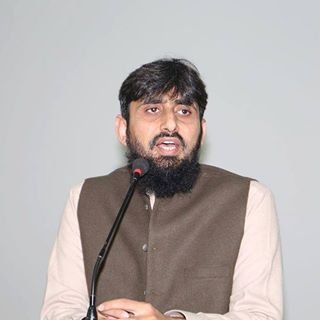
Hafiz Muhammad Zubair (b. 1979) is a Pakistani scholar of Islamic studies who teaches at Riphah International University in Lahore. He is best known in Urdu-speaking circles as a critic of the modernist readings of Javed Ahmad Ghamidi and Wahiduddin Khan, and of the online preacher Engineer Muhammad Ali Mirza, and for the many short books he has built out of his daily writing on Facebook. [1] [2]
Early life and education
He memorised the Qur’an as a boy. He went to school on the science side, passing matriculation (1995) and pre-engineering FSc (1997) with the Rawalpindi board, and then took a BA in mathematics from the University of the Punjab in 1999. [10] That year he moved to Lahore for further study, and he has lived there since. [1] Between 2000 and 2002 he completed the Dars-e-Nizami at Jamia Lahore al-Islamiyya, better known as Jamia Rahmania, which gave him a licentiate in sharia and the social sciences and the Wifaq al-Madaris degree that is recognised as an MA in Islamic studies and Arabic. In the same years he took an MA in Arabic at the University of the Punjab, followed by an MA in political science (2002–2004). He also studied tajwid and the seven and ten readings of the Qur’an. [1] [10] He began his PhD in Islamic studies at the University of the Punjab in 2003 and was awarded it in February 2012. [10] His doctoral thesis, on collective ijtihad in the present day, was later published in two volumes by the Sheikh Zayed Islamic Centre in Lahore. [2]
Controversies and criticism
Critic of modernism. Much of his work measures modern Muslim thinkers against what he calls the tradition. Tahrik-e-Tajaddud aur Mutajaddidin asks whether figures from Jamal al-Din al-Afghani, Muhammad Abduh and Rashid Rida to Sir Syed Ahmad Khan, Ghulam Ahmad Parwez, Yusuf al-Qaradawi and Tahir-ul-Qadri stand inside the tradition or outside it. [1] His Fikr-e-Ghamidi, a 427-page study, is one of the best-known critiques of Javed Ahmad Ghamidi; a 2018 journal review called him a Pakistani critic of Ghamidi’s ideology. [5] Ghamidi’s circle has answered him: Al-Mawrid’s Tanqeedaat-e-Fikr-e-Ghamidi replies to his criticisms among those of other scholars, and Ghamidi’s followers have produced video series in reply to his book on sunna. [6] [7] He wrote a similar book-length study of Wahiduddin Khan. [1]
Engineer Muhammad Ali Mirza. In January 2019, after sending written questions a month ahead, he visited Mirza’s institute in Jhelum hoping to record a question-and-answer session on Mirza’s booklet about the background of Karbala. By his own account Mirza declined to take the written questions and refused to be recorded. Zubair then released an 18-hour video series answering the booklet, later published as Engineer Muhammad Ali Mirza: Afkar o Nazariyat, and a longer book, Khilafat o Mulukiyat, reviewing the views of Mirza and of Sayyid Abul Ala Mawdudi on caliphate and kingship. He has written that Mirza’s followers responded with insults. [4] [8] [2]
Sufism and Ibn Arabi. He has written on Ibn Arabi’s idea of the finality of prophethood and on Israr Ahmad’s understanding of the unity of being (wahdat al-wujud), saying his aim was to explain Israr Ahmad’s position so that critics would understand it before attacking it. That piece drew a critical response from writers who reject wahdat al-wujud outright. [2] [9]
The face veil. He has written two books on whether women must cover the face, after a long exchange of articles on the question with Professor Khurshid. The second weighs three positions: that it is obligatory; that it is recommended, the view of Nasir al-Din al-Albani, who still held it obligatory where there is fear of temptation; and the modernist view that insisting on it is an innovation. [2]
Frank topics. Some of his booklets are unusual for a seminary-trained scholar: a guide to sex education and sexual psychology, and a short book, Asan Din (“Easy Religion”), in which he says he has deliberately shown only one side of the picture, the side that religious circles tend to leave out. [2]
Major works
His earlier research articles appeared in the quarterly Hikmat-e-Qur’an, the monthly Muhaddith and the monthly Meesaq; several of his books began as series in these journals. [2] For years he has posted a short piece almost every day on Facebook, often answering readers’ questions, and these posts were edited into collections: Mukalama (columns on more than 450 topics, from belief and unbelief to Sufism, the arts and the schools of thought) and Mukalimat, a set of ten booklets on tradition and modernity, the Islamisation of science, married life, sexuality, depression, dream interpretation, the evil eye and magic, and even travel in Pakistan’s northern areas. [1] [2]
His longer books deal with the existence of God in the light of philosophy, science and religion; the work of Western orientalists on the Qur’an, hadith and Islamic history; self-purification on the model of the first generations (Salih aur Muslih); the authority of hadith and the Sunni concept of sunna; and contemporary extremism, in a study of takfir, rebellion, jihad and the enforcement of the sharia. [1] He has also translated two works from Arabic, on teaching tajwid (2016, from Fahd al-Rumi and Muhammad al-Zaʿblawi) and on the rights of spouses, and edited an Urdu edition of ʿAbd al-Fattah al-Qadi’s work on the Qur’anic readings and the orientalists (2016). [1] [10]
As an academic he has published some sixteen journal papers, mostly between 2013 and 2019, in Urdu and English. Most grew out of his doctoral work on collective ijtihad: studies of the fatwa method of the Islamic Research Academy in Cairo and of the European Council for Fatwa and Research, of collective ijtihad and legislation, and of the ahl al-hall wa al-ʿaqd. Others deal with Qur’anic readings that are soundly transmitted but lie outside the Uthmanic text, the sunna, Islamic banking in Pakistan, bullying, and whether sharing PDF copies of books breaks copyright under the sharia. [10] All his books can be downloaded free from his website, which describes itself as a waqf (endowment); printed copies are published mainly by Dar al-Fikr al-Islami and Maktaba Rahmatul-lil-Alamin in Lahore, with further editions from Mau in Uttar Pradesh and from Srinagar. [2] [10]
Teaching career
His first post was as a teacher at Jamia Rahmania, where he taught usul al-hadith, usul al-fiqh, usul al-tafsir, creed, comparative fiqh, logic and rhetoric. From December 2004 to February 2012 he was also a teacher and research associate at the Qur’an Academy in Lahore, run by Israr Ahmad’s Markazi Anjuman Khuddam-ul-Qur’an. [1] [10] After his doctorate he spent three months, from March to May 2012, as an assistant professor at the University of Sargodha, and in August 2012 he joined the Department of Humanities at COMSATS in Lahore as an assistant professor. [10] He stayed there until 2022, and for those ten years he also gave the Friday sermon in the university mosque. In the second half of 2022 he joined Riphah International University in Lahore as an associate professor. [1]
Outside the university he teaches in mosques and online. Each Ramadan he gives a nightly summary of the Qur’an alongside the tarawih prayers at Masjid al-Rahman in Township, Lahore; the sessions are recorded for his YouTube channel. [3] His website also carries recorded courses on logic, usul al-fiqh, usul al-hadith, usul al-tafsir, comparative fiqh, Qur’anic rhetoric, Arabic grammar, inheritance law and research method. [4]
References
- “Taʿaruf” (introduction), Dr. Hafiz Muhammad Zubair’s website (his own account: name, birth, education, posts and books). drhafizmuhammadzubair.com/about/ · Wayback Machine copy of 17 December 2025: web.archive.org/web/20251217011902/https://drhafizmuhammad…
- “Tasanif” (books), Dr. Hafiz Muhammad Zubair’s website (publishers, page counts, descriptions and free downloads). drhafizmuhammadzubair.com/books/ · Wayback Machine copy of 12 April 2026: web.archive.org/web/20260412201302/https://drhafizmuhammad…
- Home page notice of the Ramadan 2025 programme at Masjid al-Rahman, Township, Lahore, Dr. Hafiz Muhammad Zubair’s website. drhafizmuhammadzubair.com
- “Video series”, Dr. Hafiz Muhammad Zubair’s website, including the series “Dialogue with Engineer Muhammad Ali Mirza”. drhafizmuhammadzubair.com/videos/ · Wayback Machine copy of 8 December 2023: web.archive.org/web/20231208082322/https://drhafizmuhammad…
- Review of Muhammad Qasim, Ghamidi Nazriyat ka Tahqiqi wa Tanqidi Jaʾiza, Afkar 2:1 (June 2018). tehqeeqat.org/urdu/articleDetails/26843
- Syed Manzoor-ul-Hassan, Tanqeedaat-e-Fikr-e-Ghamidi, Al-Mawrid US bookstore page. almawridus.org/?p=69567
- “Response to Hafiz Muhammad Zubair’s arguments”, Ask Ghamidi forum, 6 February 2024. ask.ghamidi.org/?p=93044
- Hafiz Muhammad Zubair, introduction to Engineer Muhammad Ali Mirza: Thoughts and Ideas, English translation on Tohed. en.tohed.com/threads/introduction-to-the-book-engineer-muh…
- “Review of Hafiz Muhammad Zubair’s writing titled ‘The Theory of Unity of Existence and Dr. Israr’”, Tohed. en.tohed.com/threads/review-of-hafiz-muhammad-zubairs-writ…
- “Dr. Muhammad Zubair”, staff profile, COMSATS University Islamabad, Lahore Campus (listed under staff who served previously; qualifications, experience and publications). lahore.comsats.edu.pk/employees/740
- Primary sources: his own website’s introduction page (Wayback Machine copy of 17 December 2025 linked above) and his COMSATS staff profile, which gives the dates of his degrees and posts. No Wayback Machine snapshot was checked for the COMSATS page.
- Photo: from his website (drhafizmuhammadzubair.com/assets/profile.jpg).
- Checked: 1 November 2026. Biography compiled and added to this archive: 1 November 2026.