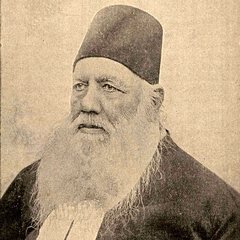
Sayyid Ahmad Khan was born in Delhi in 1817 into a family of Mughal court nobility. He received a household education in the Qur’an, Persian, Arabic and some mathematics and medicine, and in 1838 entered the judicial service of the East India Company, in which he rose to the post of subordinate judge before retiring in 1876. His early writings were conventional: a devotional account of the Prophet’s birth, Jila al-Qulub bi-Dhikr al-Mahbub, and a celebrated survey of Delhi’s monuments.
The uprising of 1857, which he witnessed at Bijnor, became the turning point of his life. In Asbab-e-Baghawat-e-Hind he argued that the revolt grew out of misgovernment and the exclusion of Indians from the councils of state, and he spent the rest of his career trying to reconcile Indian Muslims and the British crown while persuading his community to adopt modern learning. He founded the Scientific Society (1864), the journal Tahzib al-Akhlaq (1870) and, in 1875, the Muhammadan Anglo-Oriental College at Aligarh, the forerunner of Aligarh Muslim University. He was knighted in 1888.
His religious thought rested on the conviction that the word of God (the Qur’an) and the work of God (nature) cannot contradict each other. From this principle he produced a rationalist Tafsir al-Qur’an, essays on prayer, jinn and creation, a Muslim commentary on the Bible, and Essays on the Life of Mohammed, a reply to William Muir. His naturalist reading of revelation drew sharp criticism from many ‘ulama, who labelled his followers nechari, yet it opened the agenda of Islamic modernism in South Asia.
He died at Aligarh in 1898. The Aligarh movement he created shaped the Muslim professional class of India, and his arguments about Muslim political separateness are often counted among the antecedents of the idea of Pakistan.