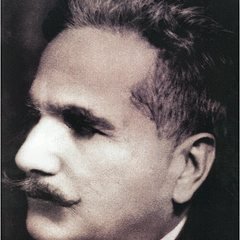
1877–1938 · British India (Punjab) · Poet, philosopher, political thinker, lawyer
Muhammad Iqbal was born in Sialkot, Punjab, in 1877. After schooling at the Scotch Mission College in his home town, he studied philosophy at Government College, Lahore, where the orientalist Thomas Arnold encouraged his interests, and he taught there after taking his MA in 1899. Between 1905 and 1908 he studied in Europe, reading philosophy at Trinity College, Cambridge, qualifying as a barrister at Lincoln’s Inn and earning a doctorate from Munich with a thesis on the development of metaphysics in Persia.
Back in Lahore he practised law, but his reputation rested on poetry. Turning from Urdu to Persian to reach a wider Muslim audience, he published Asrar-i-Khudi (1915) and Rumuz-i-Bekhudi (1918), long philosophical poems on the cultivation of the individual self (khudi) and its fulfilment within the community. Later collections, among them Payam-i-Mashriq, Bang-i-Dara, Javid Nama and Bal-i-Jibril, mixed lyric, satire and visionary narrative in a sustained critique of fatalism, imitation and Western materialism. He was knighted in 1922.
In The Reconstruction of Religious Thought in Islam (1930; enlarged 1934) Iqbal attempted a philosophical restatement of Islam in dialogue with modern thought, treating religious experience as a source of knowledge and ijtihad as the principle of movement in Islamic law. He also entered politics, sitting in the Punjab Legislative Council and, in his 1930 presidential address to the All-India Muslim League at Allahabad, proposing a consolidated Muslim state in north-west India.
Iqbal died in Lahore in 1938. He is honoured as the national poet of Pakistan, is widely read in Iran and Central Asia as a Persian poet, and remains one of the central reference points for debates on Islamic modernism, selfhood and political community.