Sufi shaykh of the Ashrafiyya line; founder of the Khanqah Imdadiya Ashrafiya and Jamia Ashraful Madaris, Karachi; Urdu poet and commentator on Rumi · 1928–2013 · Pakistan
Hakeem Muhammad Akhtar (1928 – 2 June 2013) was a Pakistani scholar, Sufi guide and Urdu poet, founder of the Khanqah Imdadiya Ashrafiya and the Jamia Ashraful Madaris in Karachi. The Muslim 500 listed him in 2010 as a Sufi scholar of the Ashrafi order who drew large audiences to his lodge for islah-e-nafs, the reform of the self, and to his talks broadcast online every day. [1][2]
Born in Pratapgarh in British India, he trained first as a practitioner of Unani medicine, graduating from the State Unani Medical College in Allahabad in 1944, before completing the traditional dars-e nizami at Bait-ul-Uloom in Sarai Mir, where he studied the six hadith collections with Abdul Ghani Phulpuri. He followed Phulpuri and later Abrarul Haq Haqqi on the Sufi path; Haqqi authorised him in the Ashrafi-Chishti, Naqshbandi, Qadiri and Suhrawardi orders. He moved to Pakistan with Phulpuri in 1960 and founded his Karachi lodge in 1980; disciples have since opened branches from Bangladesh and India to Kenya, Mauritius and Réunion. His many books on the spiritual life include Ma’arif-e Masnawi, a popular commentary on Rumi’s Masnavi, and Faizan-e Muhabbat. [1][2]
The Muslim 500: The World’s 500 Most Influential Muslims, 2010 edition, Scholarly section (listed in the editions of 2010). Free PDF of the 2010 edition
Primary sources: the Muslim 500 entries and the Wikipedia article. Archived copies: the Wikipedia article (Wayback Machine copy of 2 December 2025: web.archive.org).
Photo: Hasan2271, CC BY-SA 4.0, via Wikimedia Commons (File:Hakeem Muhammad Akhtar calligraphy.png).
Checked: 6 November 2026. Biography compiled and added to this archive: 6 November 2026.
Drafted with AI · not yet checked by the editors · Archived 6 November 2026 · Biography sources: en.wikipedia.org · themuslim500.com
Akhtar, Hakeem Muhammad. Tajalliyat-e Jazb. 1999. Archived 6 November 2026 in Islamic Internet Archives: Archive of Modern Islamic Thought. https://islamicarchives.org/works/hakeem-muhammad-akhtar-tajalliyat-e-jazb-ur/
Sufi shaykh of the Ashrafiyya line; founder of the Khanqah Imdadiya Ashrafiya and Jamia Ashraful Madaris, Karachi; Urdu poet and commentator on Rumi · 1928–2013 · Pakistan
Known for: Sufi shaykh of the Ashrafiyya line; founder of the Khanqah Imdadiya Ashrafiya and Jamia Ashraful Madaris, Karachi; Urdu poet and commentator on Rumi
Era: Revival & Independence (1947–1979); Global Islamic Resurgence (1979–2000); Contemporary Islam (2000–today)
Subjects: Sufism
Works in this archive: 1
Hakeem Muhammad Akhtar (1928 – 2 June 2013) was a Pakistani scholar, Sufi guide and Urdu poet, founder of the Khanqah Imdadiya Ashrafiya and the Jamia Ashraful Madaris in Karachi. The Muslim 500 listed him in 2010 as a Sufi scholar of the Ashrafi order who drew large audiences to his lodge for islah-e-nafs, the reform of the self, and to his talks broadcast online every day. [1][2]
Born in Pratapgarh in British India, he trained first as a practitioner of Unani medicine, graduating from the State Unani Medical College in Allahabad in 1944, before completing the traditional dars-e nizami at Bait-ul-Uloom in Sarai Mir, where he studied the six hadith collections with Abdul Ghani Phulpuri. He followed Phulpuri and later Abrarul Haq Haqqi on the Sufi path; Haqqi authorised him in the Ashrafi-Chishti, Naqshbandi, Qadiri and Suhrawardi orders. He moved to Pakistan with Phulpuri in 1960 and founded his Karachi lodge in 1980; disciples have since opened branches from Bangladesh and India to Kenya, Mauritius and Réunion. His many books on the spiritual life include Ma’arif-e Masnawi, a popular commentary on Rumi’s Masnavi, and Faizan-e Muhabbat. [1][2]
The Muslim 500: The World’s 500 Most Influential Muslims, 2010 edition, Scholarly section (listed in the editions of 2010). Free PDF of the 2010 edition
Primary sources: the Muslim 500 entries and the Wikipedia article. Archived copies: the Wikipedia article (Wayback Machine copy of 2 December 2025: web.archive.org).
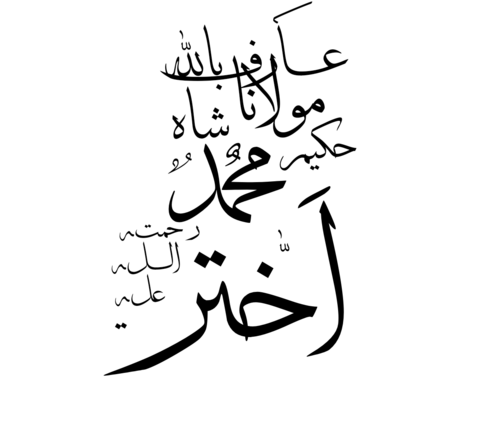
Photo: Hasan2271, CC BY-SA 4.0, via Wikimedia Commons (File:Hakeem Muhammad Akhtar calligraphy.png).
Checked: 6 November 2026. Biography compiled and added to this archive: 6 November 2026.