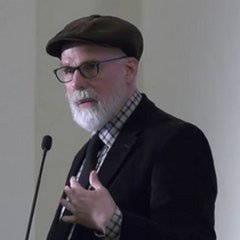
b. 1948 · United States · American Muslim theologian, scholar of Islamic law and history, scholar-in-residence of The Oasis Initiative
Umar Faruq Abd-Allah was born Wymann Landgraf in 1948 in Columbus, Nebraska, into a Protestant family, and grew up in Athens, Georgia, where his parents taught at the University of Georgia; his father taught veterinary medicine and organic chemistry and his mother English. In 1964 the family moved to the University of Missouri, where he took a double major in history and English literature. He won a Woodrow Wilson Fellowship in 1969 and began a doctorate in English literature at Cornell University. In early 1970, after reading The Autobiography of Malcolm X, he embraced Islam. In 1972 he moved to the University of Chicago to study Arabic and Islamic studies under Fazlur Rahman, and in 1978 he took his doctorate with honours, with a dissertation on the origins of Islamic law centred on Imam Mālik’s concept of ʿamal.
From 1977 to 1982 he taught at the Universities of Windsor, Temple and Michigan. In 1982 he moved to Spain to teach Arabic, and from 1984 to 2000 he taught Islamic studies and comparative religion, in Arabic, at King Abdul-Aziz University in Jeddah, studying meanwhile with traditional scholars. He returned to Chicago in 2000 as chair and scholar-in-residence of the Nawawi Foundation, for which he wrote his best-known papers. In 2012–2013 he taught Islamic studies at the Darul Qasim Institute in Chicago. He is now scholar-in-residence of The Oasis Initiative in Chicago, which publishes his work, and is also listed as a consultant scholar of Kalam Research & Media; he does independent research, writing and teaching, and lectures in North America, Europe and West Africa. The Muslim 500 lists him among its scholarly sources of influence.
His writing ranges over theology, spirituality, law and legal theory, and history. His first book was The Islamic Struggle in Syria (1983). A Muslim in Victorian America (2006) is a life of Alexander Russell Webb, an early American convert to Islam. Mālik and Medina (2013) studies the legal reasoning of Imam Mālik in the formative period of Islamic law. His Arabic treatise al-Īmān fiṭra (2014) deals with the innate disposition to faith in the Qur’an and Sunna. He has also translated and commented on the devotional sequence attributed to Imam al-Nawawī (2020).
He is described as a prominent figure in Islamic neo-traditionalism, and Walaa Quisay’s Neo-Traditionalism in Islam in the West (2023) studies him with Hamza Yusuf and Abdal Hakim Murad. His papers on Islam and culture, mercy, creativity and the Muslim presence in America are free to read on The Oasis Initiative website, and many of his lectures and interviews are online; the archive links to those copies, and also to reviews of his books and writing about him.