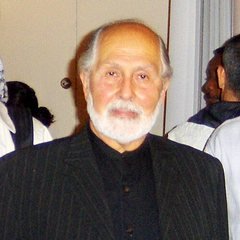
b. 1933 · Iran; United States · Philosopher, historian of science, Traditionalist, Islamic studies scholar
Seyyed Hossein Nasr was born in Tehran in 1933. His father, Sayyid Valiallah Nasr, was a physician and educator from a scholarly family, and Nasr received a traditional Persian and religious grounding before being sent to school in the United States at the age of twelve. He took a degree in physics at the Massachusetts Institute of Technology and then studied geology and the history of science at Harvard, where his doctoral thesis on conceptions of nature in Islamic thought became An Introduction to Islamic Cosmological Doctrines. In these years he encountered the Traditionalist writers René Guénon and Frithjof Schuon, who shaped his thinking permanently.
Returning to Iran in 1958, he taught philosophy and the history of science at Tehran University, studied with traditional masters of Islamic philosophy, and rose to senior academic posts, including the presidency of Aryamehr University and the founding directorship of the Imperial Iranian Academy of Philosophy. The 1979 revolution caught him abroad, and he settled in the United States, teaching at Temple University and, from 1984, at George Washington University.
Nasr is the most prominent Muslim representative of the perennialist or Traditionalist school, which holds that a single metaphysical truth underlies the revealed religions. Across more than fifty books he argued that modern thought had cut knowledge off from the sacred, and that Muslims should preserve their intellectual, spiritual and artistic tradition rather than adopt either secular modernism or what he saw as reactive fundamentalism. The Encounter of Man and Nature made him an early voice linking the ecological crisis to a spiritual one, and his Gifford Lectures, Knowledge and the Sacred, set out his idea of sacred science. He also wrote widely on Islamic philosophy, science, art and Sufism for both Muslim and Western readers.
His later projects include The Study Quran, an annotated translation he edited, and he has been the subject of a volume in the Library of Living Philosophers.