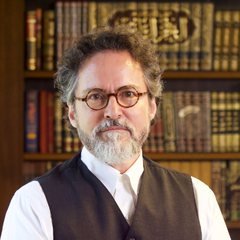
b. 1958 · United States · Scholar, educator, translator, co-founder of Zaytuna College
Hamza Yusuf was born Mark Hanson in Walla Walla, Washington, in 1958 and grew up in northern California, where he was raised in the Greek Orthodox Christianity of his mother’s family. After a serious car accident and a period of reading on religion, he embraced Islam in 1977. He then spent about a decade studying abroad: first at the Islamic studies institute of the United Arab Emirates University, where he learned Arabic, Mālikī law and theology, and later in Algeria, Morocco and especially Mauritania, where he studied with the scholar Murabit al-Hajj in the traditional desert schools.
On his return to the United States he trained in nursing and took a degree in religious studies at San José State University, later completing a doctorate at the Graduate Theological Union in Berkeley in 2020. In 1996 he co-founded the Zaytuna Institute in California with Zaid Shakir and Hatem Bazian, aiming to revive classical Islamic learning in the West. It developed into Zaytuna College, a four-year Muslim liberal arts college that received regional accreditation in the 2010s; he serves as its president and edits its journal Renovatio.
Yusuf’s writing combines translations of classical Arabic texts, many of them standard works of the Mauritanian and Maghribi curriculum, with essays on education, ethics and modern culture. His translations include al-Būṣīrī’s Burda, Imam Mawlūd’s poem on the diseases of the heart (Purification of the Heart, 2004) and The Creed of Imam al-Tahawi (2007). He emphasises Ashʿarī theology, Mālikī law, Sufi ethics and the liberal arts as the basis for a confident Western Muslim identity.
A prominent public speaker, he has also worked with Shaykh ʿAbd Allāh bin Bayyah in initiatives on peace and religious authority, roles that have drawn both support and criticism. He is regularly listed among the most influential Muslims in the world.