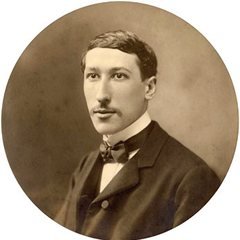
1886–1951 · France; Egypt · Metaphysician, Sufi, traditionalist writer, critic of modernity
René Guénon was born in Blois, France, in 1886 into a Catholic family. He went to Paris to prepare for the entrance examinations of the grandes écoles in mathematics, but abandoned them and spent his early years in the city’s occult and esoteric milieus. He soon turned against these circles and began to search instead for what he regarded as authentic, regular traditions. Around 1910 he came into contact with Islamic esotericism, and he was received into a Sufi lineage, the Shādhilī order associated with the Egyptian scholar ʿAbd al-Raḥmān ʿIllaysh, through the Swedish convert Ivan Aguéli.
From the 1920s Guénon published a series of French books arguing that the modern West had cut itself off from metaphysical principles which were preserved, in differing forms, in the traditional religions of the East. Orient et Occident (1924), La Crise du monde moderne (1927) and Le Règne de la quantité et les signes des temps (1945) present modernity as a phase of decline marked by individualism, materialism and the loss of spiritual authority. His writings on initiation, symbolism and the doctrine of the Universal Man drew heavily on Sufi sources.
In 1930 he travelled to Cairo and settled there permanently, living as a practising Muslim under the name ʿAbd al-Wāḥid Yaḥyā. He married into an Egyptian religious family, became an Egyptian citizen in 1949, and continued to write articles for the Paris journal Études traditionnelles until his death in Cairo in January 1951.
Guénon is regarded as the founder of the Traditionalist or Perennialist school, whose later figures include Frithjof Schuon, Titus Burckhardt and Martin Lings. His critique of modernity and his account of Sufism as the inner dimension of Islam shaped Western interest in Islamic spirituality and influenced a number of Muslim intellectuals in Europe and the Muslim world. Articles on Islam and Sufism were gathered after his death in Aperçus sur l’ésotérisme islamique et le taoïsme (1973).