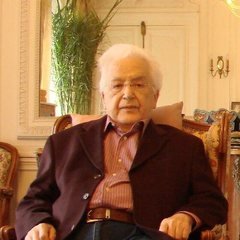
1928–2010 · Algeria; France · Historian of Islamic thought, philosopher, Islamologist
Mohammed Arkoun was born in 1928 in Taourirt Mimoun, a Berber-speaking village in Kabylia, then part of French Algeria. After secondary schooling in Oran he studied Arabic literature at the University of Algiers, and continued his studies at the Sorbonne, where he passed the agrégation in Arabic in 1956 and completed a doctorate in 1968 on the tenth-century philosopher and historian Miskawayh. He taught at Lyon and then for two decades at the Sorbonne Nouvelle (Paris III), and later held visiting posts in Europe and North America and was associated with the Institute of Ismaili Studies in London.
Arkoun’s central project, announced in Pour une critique de la raison islamique (1984), was to examine Islamic thought with the tools of modern linguistics, history, anthropology and philosophy. He proposed an “applied Islamology” that would study Muslim societies as they are rather than as normative texts describe them. He drew attention to what had become impensable or impensé (unthinkable or unthought) within orthodox traditions, and treated the Qurʾan as a historical discourse whose oral, written and interpreted forms needed to be distinguished, a theme of Lectures du Coran (1982).
His books, among them La Pensée arabe (1975), Essais sur la pensée islamique (1973), Ouvertures sur l’islam (1989; English Rethinking Islam, 1994) and The Unthought in Contemporary Islamic Thought (2002), were widely translated, and the Arabic versions prepared by Hāshim Ṣāliḥ gave him a large readership in the Arab world. He also wrote on humanism, secularism and the place of Islam in France and Europe.
Arkoun died in Paris in 2010 and was buried in Casablanca. Admired by many as a pioneer of critical, historically minded study of the Islamic tradition and criticised by others for subordinating revelation to secular method, he remains a reference point in debates on Islamic reform and modern hermeneutics.