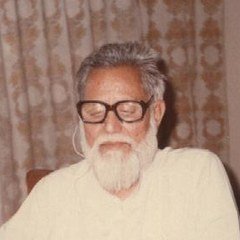
1904–1997 · Pakistan · Scholar, Qur'an commentator, pupil and interpreter of Hamiduddin Farahi
Amin Ahsan Islahi was born in 1904 in the village of Bamhur in the Azamgarh district of British India and graduated from the Madrasatul Islah in 1922. He first worked in journalism, editing and contributing to Urdu periodicals, until in 1925 the Qur’an scholar Hamiduddin Farahi invited him to study with him. Islahi became Farahi’s chief disciple, and after Farahi’s death he studied hadith with Abdul Rahman Mubarakpuri and in 1936 founded the Daira-i Hamidiyya to spread Farahi’s ideas.
He was a founding member of the Jamaat-e-Islami in 1941 and sat on its central council for some seventeen years, serving in the 1950s on Pakistan’s Islamic Law Commission. He left the party in 1958 after disagreements with its leader Abul A’la Maududi, partly over the role of electoral politics, and thereafter devoted himself to Qur’anic study and teaching in Lahore.
His major work is the nine-volume Urdu commentary Tadabbur-i Qur’an, begun in 1958 and finished in 1980, which applies Farahi’s principle that each sura and the Qur’an as a whole has a unifying structure and theme (nazm). Alongside it he wrote shorter books on faith and practice, among them studies of polytheism, monotheism, prayer and piety, and on Islamic law, the state and the status of women, as well as works on method in understanding the Qur’an and hadith.
In 1981 he established the Idara-i Tadabbur-i Qur’an-o Hadith, which publishes the journal Tadabbur. He died in Lahore in 1997. His students included Khalid Masud and Javed Ahmad Ghamidi, through whom his approach to the Qur’an has continued.