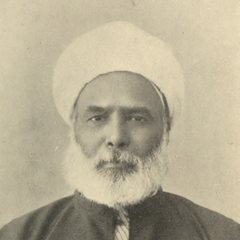
Muḥammad ʿAbduh was born in 1849 in the Nile Delta province of Buḥayra and grew up in a farming family in the village of Maḥallat Naṣr. After an unhappy start at the Aḥmadī mosque school in Ṭanṭā, he was drawn to Sufism through an older relative, Shaykh Darwīsh Khaḍr, and went on to al-Azhar. There, from the early 1870s, he joined the circle of Jamāl al-Dīn al-Afghānī, who introduced him to philosophy, theology and political journalism.
ʿAbduh taught at Dār al-ʿUlūm and edited the official gazette, but his support for the ʿUrābī movement led to his exile in 1882. In Paris he published al-ʿUrwa al-wuthqā with al-Afghānī (1884), then lived in Beirut, where he taught and prepared his commentary on Nahj al-balāgha. Allowed back to Egypt in 1888, he served as a judge, sat on the administrative council of al-Azhar, and in 1899 became Grand Mufti of Egypt, a post he held until his death.
His theology, set out in Risālat al-tawḥīd (1897), held that revelation and reason cannot truly conflict and that Islam, rightly understood, encourages science and moral responsibility. He criticised blind imitation (taqlīd) in law, urged a return to the Qurʾān and the practice of the early Muslims, and pressed for reform of al-Azhar, the sharīʿa courts and religious endowments. His lectures on the Qurʾān became the basis of Tafsīr al-Manār, completed by his student Rashīd Riḍā, and he answered European critics of Islam in al-Islām wa-l-naṣrāniyya maʿa al-ʿilm wa-l-madaniyya.
ʿAbduh died in Alexandria in 1905. He is widely treated as the central figure of Islamic modernism, and both liberal reformers and the Salafi current that came through Riḍā drew on his ideas.